What Size Wall Art Should You Choose for a Coastal Living Room? A Photographer's Practical Guide
I get asked this one a lot. Someone finds a print they love, adds it to cart, then freezes. "But what size should I get?" It's honestly one of the most common questions I hear, and I get it. Sizing wall art feels like a big commitment, especially when you're buying online and can't hold it up against the wall first.
So here's my honest, practical take on how to choose the right size wall art for a living room. No fluff, just the stuff that actually helps.
Start With Your Wall, Not Your Gut Feeling
Most people undersize their wall art. It's the number one mistake I see. A small print on a big wall looks lost, and it makes the whole room feel unfinished. If you're thinking about choosing wall art for a living room, bigger is almost always better.
Here's a rough guide to get you started:
- Small feature wall or narrow hallway: M size (42x59.4cm) is a solid choice
- Standard living room wall: L (59.4x84.1cm) or XL (84.1x118.9cm) tends to work well
- Large feature wall or open plan living: Go EPIC (100x150cm). It's 1.5 metres wide and it genuinely commands a room
- Above a couch: Aim for a print that's roughly two thirds the width of the couch
The EPIC size is something I added because so many customers were asking for something really statement-making. When you see it on a wall, you understand why.
Above the Couch: The Most Common Placement Question
The living room couch is probably the most common spot people hang coastal wall art in Australia, and it trips a lot of people up. The rule I always tell people is to measure the couch first. If your couch is 2 metres wide, you want your artwork to be at least 130cm wide. That's where the EPIC size really earns its name.
Hang it so the bottom of the frame sits about 20 to 25cm above the back of the couch. That keeps it connected to the furniture rather than floating up near the ceiling.
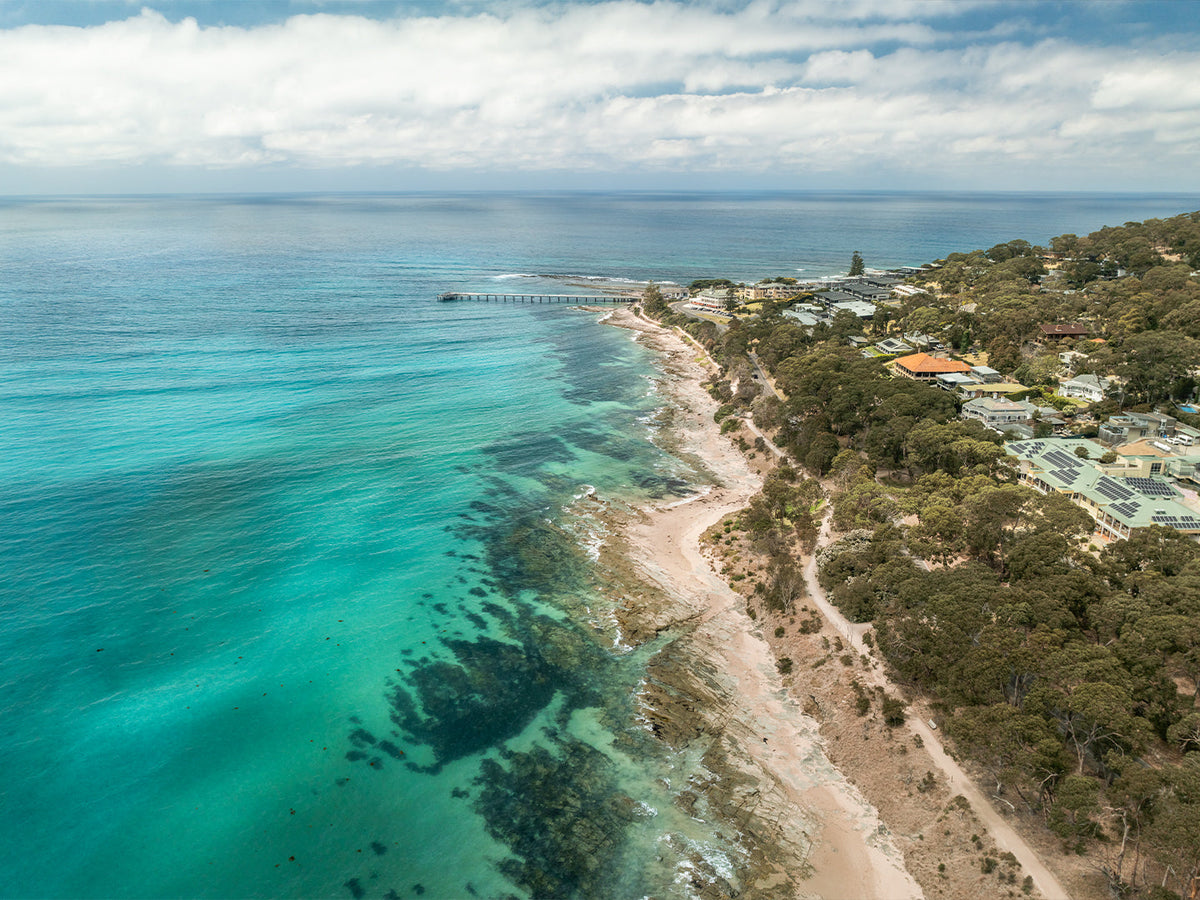
If you want something bold above a three-seater, the Point Addis Art Print I in XL or EPIC looks incredible. It's one of my most popular prints for a reason. Shot from above on a still morning, the colours of the water and the limestone cliffs are genuinely unlike anything else I've captured on the Surf Coast.
What About a Gallery Wall?
Gallery walls are a great option if you want to cover more space without committing to one very large piece. For a coastal living room, I'd suggest mixing two or three prints in complementary sizes. For example, one M and two S prints grouped together can fill a wall really nicely without feeling chaotic.
The key is keeping the frames consistent. All black, all white, or all oak. Mixing frame colours makes a gallery wall look accidental rather than intentional. I'd also stick to prints from the same coastline or region so the collection feels cohesive.
The Bells Beach Art Print I and Torquay Art Print I pair really well together for a Surf Coast gallery wall. Both are strong sellers and they work beautifully side by side.
For more on how to choose between print formats for your space, this post is worth a read: Coastal Art Print vs Canvas: Which Format Is Right for Your Australian Home?
Which Format Works Best in a Living Room?
For coastal wall art in a living room, I most often recommend the classic framed print or the floating frame canvas. Both suit living rooms well, but for different reasons.
The classic frame uses 250gsm art paper with archival giclee inks, solid FSC certified timber and glass front. It's clean, sharp, and the most popular option I sell. It comes in black, white or oak and has a 10-year warranty.
The floating frame canvas has no glass at all, which means zero reflections. If your living room gets a lot of afternoon sun, that's a real advantage. It uses museum quality 400gsm Hahnemuhle Daguerre canvas and looks genuinely beautiful in a brighter space.
If you're in a room with lots of natural light and want the sharpest possible image quality, the premium shadow box with Tru Vue Museum Glass is worth considering. It blocks 99% of UV and virtually eliminates glare. It's a proper upgrade for a room where the art is really going to be on show.
You can see the full breakdown at the product guide or check the size guide if you want visual examples of each size on a wall.
Bring a Place You Love Into the Room
The best coastal wall art for a living room isn't just filler. It's the print that makes someone walk in, stop, and say "where is that?" It's the one you chose because it's your beach, your stretch of coast, the place where you feel like yourself.
Every print I sell starts from $89 and ships free anywhere in Australia. All printed to order and sent from Victoria. There's no pickup, but that also means it arrives ready to hang, wherever you are.
Browse the full collection and find the print that belongs in your living room.
Frequently Asked Questions
What size wall art should I get for a living room?
For most living rooms, an L (59.4x84.1cm) or XL (84.1x118.9cm) print works well as a single statement piece. If you have a large feature wall or an open plan space, the EPIC size at 100x150cm is 1.5 metres wide and really fills the room. The most common mistake is going too small, so if you're unsure, size up.
How do I know what size print to hang above my couch?
Aim for artwork that's roughly two thirds the width of your couch. So if your couch is around 200cm wide, you want a print that's at least 130cm across. Hang it about 20 to 25cm above the back of the couch so it feels grounded to the furniture rather than floating on its own.
Is coastal wall art in Australia better as a framed print or a canvas?
Both work well in a living room, but the choice usually comes down to light. The floating frame canvas has no glass, so it's ideal for rooms with strong natural light where reflections could be a problem. The classic framed print suits most living rooms and is the most popular option at Local Breaks. The product guide at localbreaks.com.au/pages/product-guide has a full comparison.
How many prints should I use for a gallery wall in a living room?
Two to three prints in complementary sizes tends to work best for a coastal gallery wall. A good starting combination is one M print and two S prints grouped together. Keep the frame colour consistent across all pieces and choose prints from the same coastline or region so the wall feels intentional rather than random.
Still not sure on size? The size guide is a good place to start, or feel free to reach out and I'll help you figure it out.